First, get the real document.
The summary a free app shows you is not your file. It is a highlights reel. Federal law gives you something wider: a full file disclosure — everything in your file at the bureau, where each item came from, and who has received your report. That right is in the Fair Credit Reporting Act, section 609 (15 U.S.C. § 1681g), and the bureau has to answer when you ask.
Start there, or with your free reports at AnnualCreditReport.com. Then read in the order below. The order matters: the mistake most people make is starting with the scariest account. Start with the boring page. It is the one that poisons everything else.
The five sections, in reading order.
Reports from the three bureaus look different, but they carry the same five sections. Read them in this order — not the order they happen to appear in.
WHAT TO CHECK
Wrong names, old addresses, and a stranger's employer are not small things. This is the page that decides whether the rest of the file is even about you. We fix it before any account is disputed.
The tab that matters most is the one nobody opens first: personal information. A wrong address is how someone else's account ends up on your file, and how your dispute later gets matched to the wrong person.
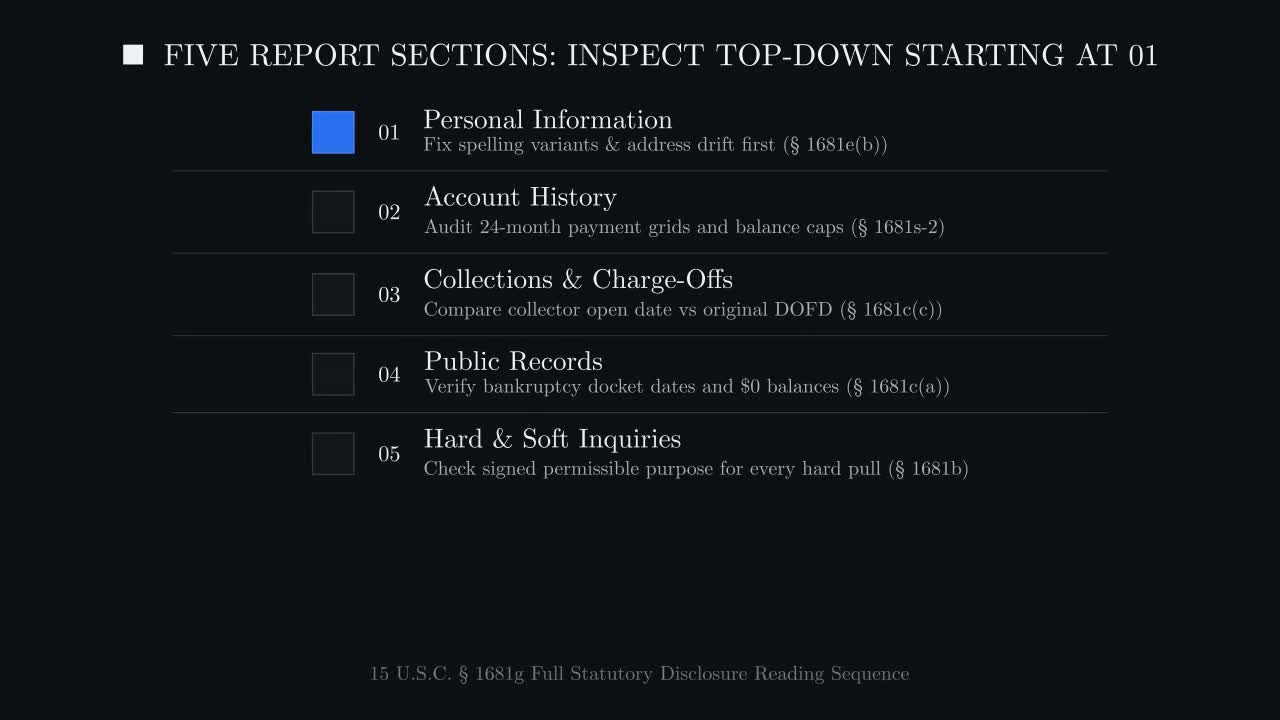
The diagram is the map; the tabs above are the territory. Five sections, one reading order — identity, accounts, collections, inquiries, and the public-record page most files mercifully leave blank.
The three dates that decide everything.
Almost every argument about a credit report is really an argument about a date. There are three, and they do three different jobs. Confusing them is how people get talked into paying debts that cannot legally stay on their report.
The month you first fell behind and never caught up. This date starts the reporting clock, and it is fixed by law — the creditor has to report the real one. It does not move when the debt is sold, and it does not move when you make a payment.
Seven years after the date of first delinquency, a collection or charge-off must come off your report. The statutory period runs from 180 days after the DOFD (FCRA §1681c(c)(1)); bureaus display fall-off at DOFD + 7 years in practice.
A separate clock about being sued, set by state law, not the credit law. This is the one clock a payment or a written promise can restart in some states — which is why what you say to a collector matters.
The date of first delinquency is March 2019. Seven years later is March 2026 — that is the fall-off date for the collection or charge-off. If it is still reporting in April 2026, the window closed. You are not asking for a favor when you demand deletion; you are asking the bureau to follow its own clock. The lawsuit clock is separate, and in some states a payment or a written promise can restart it.
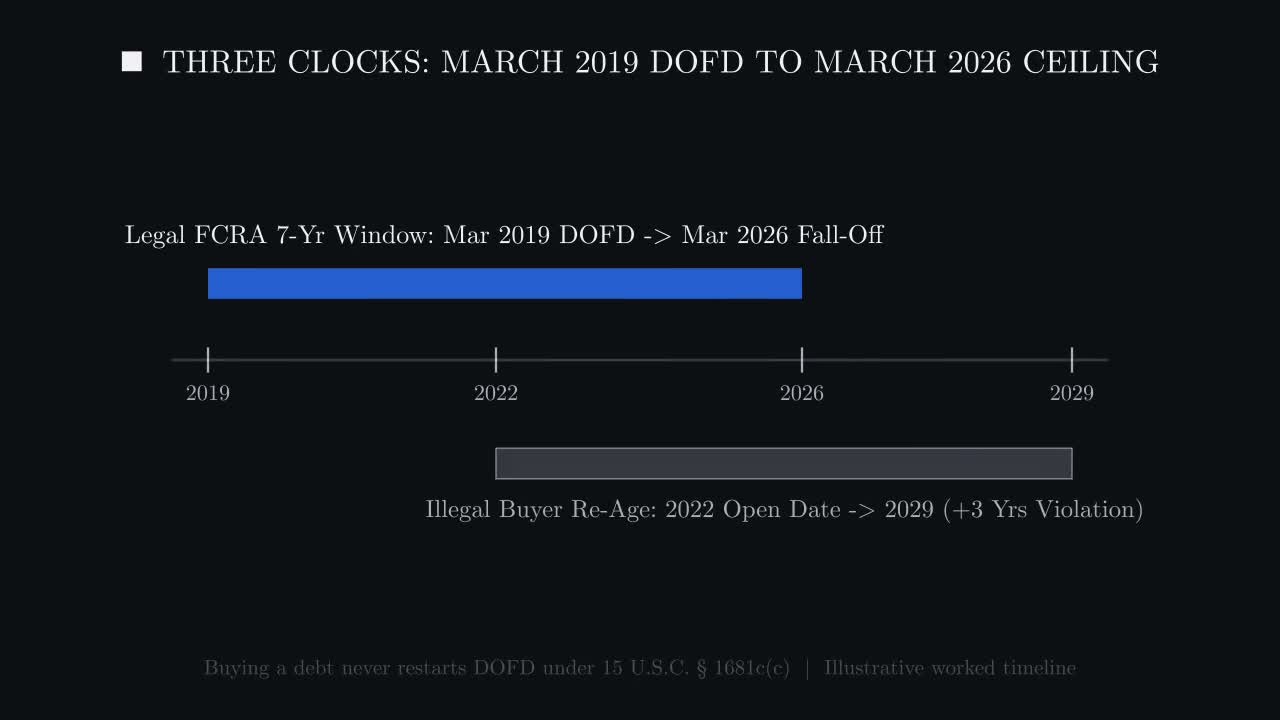
Check the dates before disputing, paying, or settling anything. They are the cheapest fact to verify and the most expensive one to get wrong.
Re-aging, named and explained.
If a collector or a new debt buyer reports a newer first-delinquency date than the original creditor did, that is called re-aging, and it is illegal. Furnishers must report the original date (FCRA §1681s-2(a)(5)). A changed date is one of the strongest marks you can find — it is wrong on its face, on every bureau, every time.
The true date of first delinquency. The reporting clock starts here, and it does not restart when the account is sold.
A newer date on the same debt. That is re-aging — the clock was restarted on paper. Furnishers must report the original date (§1681s-2(a)(5)).
Detection is a comparison, not a guess: put the collection's DOFD next to the original account's. A newer date means you caught them. This is also the cleanest attorney-referral signal in the file — a provably re-aged account is a documented FCRA problem, not a he-said/she-said.
Mark what looks wrong: the four-line check.
You do not need a law degree to mark a report. You need four questions, asked of every single item. An item that fails any one of them is a dispute candidate — write it down with the line it failed.
Line 1 (is it yours?) — the debt is yours. Line 2 (balance right?) — $1,840 reported against $1,212 on the last statement. Line 3 (dates right?) — the DOFD moved from 2019 to 2022. Line 4 (matches across bureaus?) — Equifax shows $1,840, TransUnion shows $1,212. Three failed lines. That is a dispute with three specific reasons, not a letter that says “this is not mine.”
That marked-up report is the starting point of every real dispute. What you do with the marks is the next page of the library: the Letter Pack.
Watch the anatomy.
The film is about 24 seconds. It autoplays when you reach it, and it keeps playing while the page scrolls normally — no scrubbing, no pinning.
I don't want to dispute anything. I just want to know what's on my file.
Then read it. The reading is free, and nothing is filed without you.
A dispute is a move you make, not a side effect of reading. The investigation marks what looks wrong and tells you what it found. You decide what happens next. If nothing fits, you keep the report and the library.
What this guide just gave you.
Keep the pages. They are yours whether or not you ever use the scan. This is education, not financial or legal advice.
The next door is the one you choose.
If you want the whole file read for you, the free report is the door. If you want to keep reading, your marks already have a destination: next in the library, the Letter Pack (Guide 03) — the five letters, and the mechanics that turn your marks into paper a bureau has to answer. And when the marks are made and the file needs assembling, the Perfect File Checklist (Guide 04) is the page that puts it in order.
FREE REPORT · FREE INVESTIGATION · $0 TO START · NO CARD · NO HARD PULL
One email. The lesson series, the new instruments as they land, and the scan invite. The guides stay ungated either way.
Or keep reading. The library is a chain, not a dead end.
We read your whole file. Then we match you to the attorney program that fits.
This is education, not financial or legal advice. Every case is different. You may qualify — the free report is how anyone finds out.